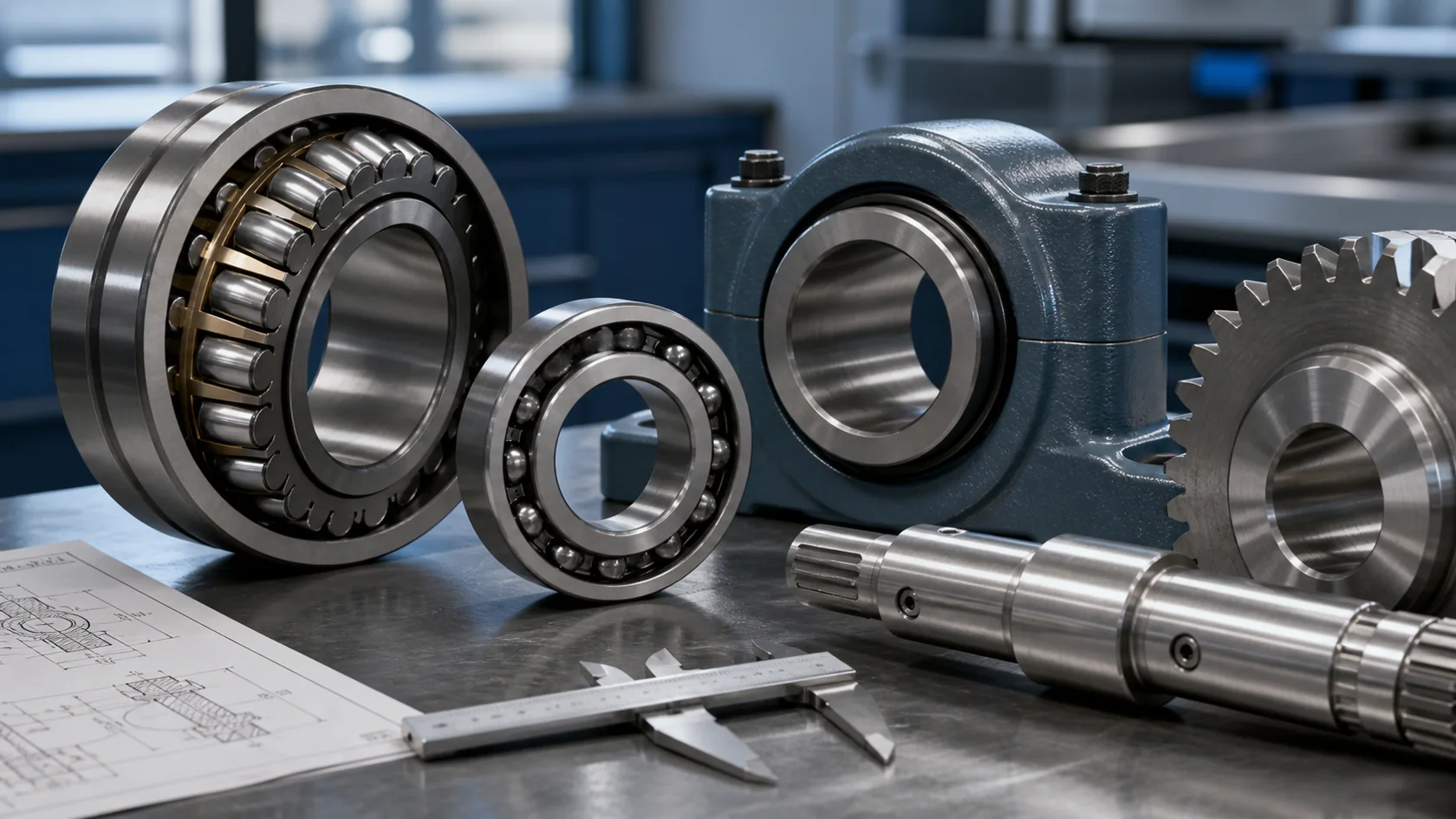
Two bearings with the same bore, outside diameter and width may still differ in internal design, clearance, sealing, cage, precision or load capability. Identification should therefore preserve the original designation and the installed operating context. A readable marking, three main dimensions and the equipment application are enough to begin identifying the next questions.
This guide supports the Bearings, Motion & Mechanical Components product system and helps prepare a structured enquiry.
1. Record every marking before measuring
Photograph both faces, the outer ring, seals or shields, housing labels and packaging if it is reliable. Write the designation exactly as shown, including spaces, prefixes and suffixes. The basic designation commonly identifies type and size; prefixes and suffixes can describe manufacturer-specific design features.
2. Confirm the main dimensions
Measure bore diameter, outside diameter and width with the correct tool and units. For flanged bearings, mounted units or housings, also record bolt centres, flange dimensions, shaft height and the surfaces that locate the assembly.
Core dimensional record
- Bore diameter (d)
- Outside diameter (D)
- Ring or assembly width (B/C/T as applicable)
- Flange, shoulder, snap-ring or housing geometry
- Shaft and housing interface
3. Identify the bearing construction
Record whether the rolling elements are balls or rollers, the number of rows, contact arrangement, self-aligning or separable features and whether the item is a bearing, insert, housing or complete mounted unit. A clear cross-sectional view is useful only when safe and practical.
4. Preserve seal, shield and clearance information
Open, shielded and sealed bearings manage friction, lubricant retention and contamination differently. Internal-clearance suffixes are also significant because mounting fit and operating temperature can change running clearance. Do not delete a suffix simply because the envelope dimensions match.
5. Describe the installed duty
State the equipment, shaft position, speed if known, load direction, vibration, shock, misalignment, temperature, dust, water and lubrication method. Explain whether the replacement is routine, premature failure or a redesign question.
6. Send a comparable enquiry
Combine the marking record, dimensions, construction, operating duty, quantity, destination and required timing. If the original designation is uncertain, label assumptions clearly and retain the sample until dimensional and construction questions are resolved.
One readable marking photograph, one complete product view, three main dimensions and the equipment application will usually produce better questions than a generic request for “the same bearing.”
Public technical references
- Schaeffler Technical Pocket Guide — bearing designations, prefixes, basic designations and suffixes.
- SKF Bearing Basics — sealing, shielding and internal-clearance context.
- NTN Americas Tolerance Tables — bearing external dimensions and dimensional-accuracy terminology.
These references explain general bearing-identification principles. Interchangeability, ratings and suitability must be reviewed for the specific bearing and application.