Engineered industrial components

Wear, sealing & flow components.

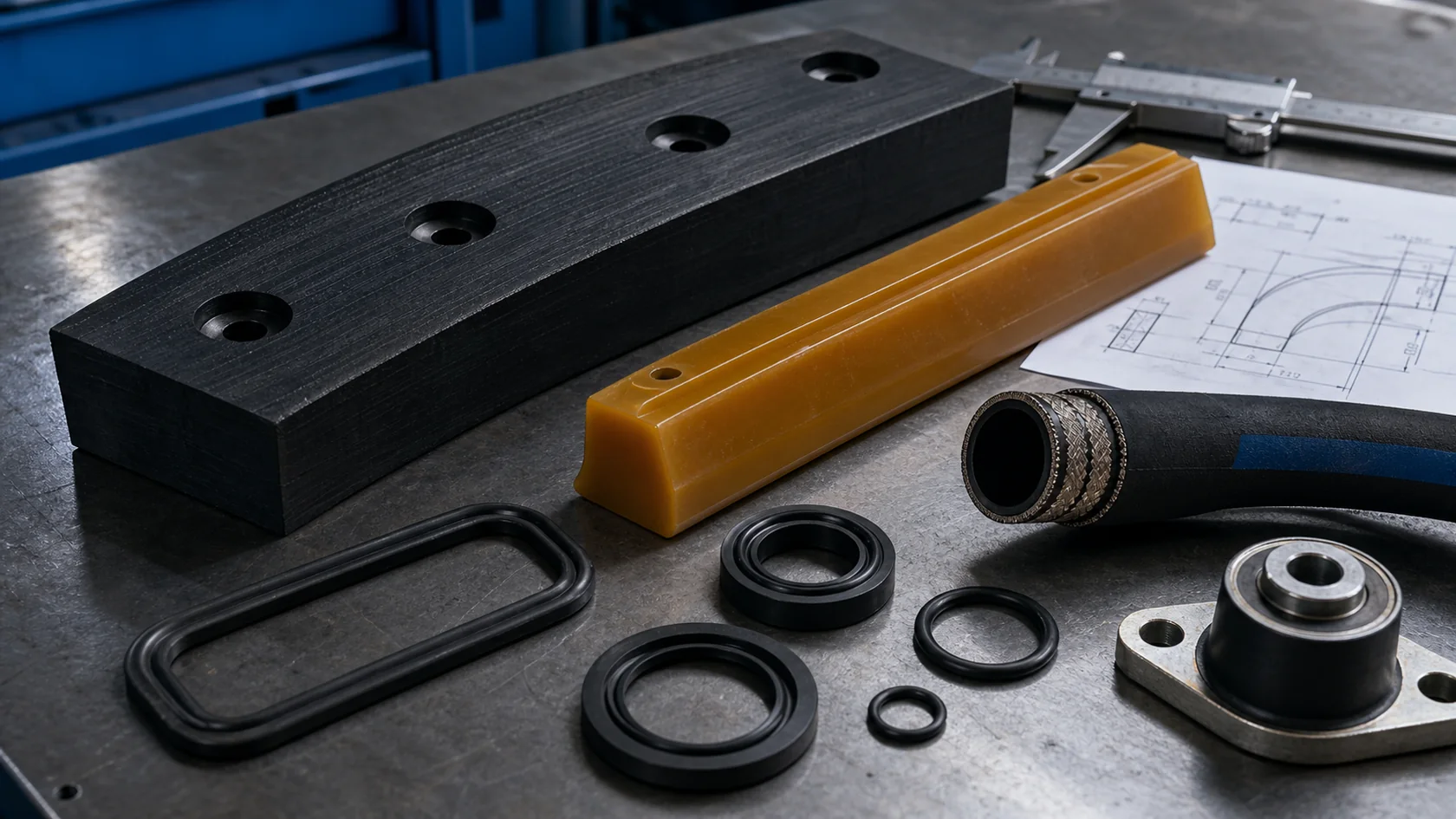
Bring us the application, drawing, photo or sample. We compare rubber and polyurethane forms, identify critical interfaces and coordinate a manufacturing route for replacement or custom components.

  • Wear protection
  • Equipment sealing
  • Replacement & custom

Product comparison

Sealing, wear & fluid handling.

Different parts. Different jobs. Sealing a joint, controlling fluid around a moving rod and protecting a chute call for different component designs.

01

O-rings & molded gaskets

Covers, housings, flanges and sealed joints

How it works

An O-ring seals through deformation in its groove. A molded gasket follows the joint profile, including corners and fixing points.

Selection & comparison details

Compare cross-section, groove, compression and medium exposure. Select the compound for the actual medium and operating conditions.

02

Rod & piston sealing components

Hydraulic or pneumatic cylinders and linear-motion equipment

How it works

A rod seal acts against the moving rod; a piston seal acts against the cylinder bore. Wipers and guide rings perform separate supporting jobs.

Selection & comparison details

Match the seal position and profile before comparing compounds. Pressure, speed, fluid, temperature, clearance and surface condition influence the design.

03

Rubber & PU wear components

Chutes, transfer points, skirting and scraping positions

How it works

Liners protect surfaces; skirting contains material at belt edges; scrapers work at a contact edge. Each has different wear and mounting needs.

Selection & comparison details

Separate sliding abrasion from impact. Compare profile, backing or inserts, fastening and access for replacement alongside the rubber or polyurethane construction.

Technical references

These references support the general product and application explanations. The confirmed drawing and offer define the specific product requirement.

Rotating equipment

Mechanical seals: faces, secondary seals and equipment fit.

For pumps, mixers and other fluid-handling equipment, compare seal faces, secondary seals, process media and the flush or cooling arrangement.

Seal faces
Rotating and stationary faces form the sealing pair. Face materials need to suit the medium and operating conditions.
Secondary seals
O-rings or other secondary elements seal additional leakage paths; their compounds must suit the medium and temperature.
Installation & operation
Working length, chamber and drive fit belong alongside flushing, cooling and start-up conditions in the replacement review.

Keep the complete designation, equipment reference, installation dimensions and photographs of the existing seal together for the arrangement review.

Working with Youketong

Start with the information available today.

Share the part information and application you have. We identify the next inputs needed for product comparison, fit and quotation.

Useful starting information

  • Existing component, sample or drawing
  • Installed interface, profile and known dimensions
  • Equipment, medium, movement and duty information
  • Observed leakage, wear, deformation or fit problem
  • Sample, tooling or repeat-order objective
Read the product identification guide →

From product review to an order plan

Comparable proposal
A profile, compound, backing or insert and mounting basis that can be compared against the same drawing, sample or part reference.
Verification plan
Agreed dimensional, profile, hardness or bonding checks, with factory review or independent testing added when the order requires it.
Repeat-order record
Confirmed specification, sample or tooling responsibilities, packing and production information retained as the basis for repeat enquiries.
Hebei manufacturing contextRubber and sealing specialization in Julu, Renze and Jingxian

Our Hebei base gives us a closer operating context for regional products and processes. We use it to compare manufacturing responses for the specific component, not as a substitute for product-level verification.

Explore the regional industry references →
Wear and sealing enquiry

Give us the part. We will organize the next manufacturing discussion.

Share a drawing, dimensioned sketch, clear photographs or a sample status together with the application, quantity, destination and timing. We will identify the missing questions and coordinate the offer basis.

Discuss a component